by Eliška Pituchová
As evidenced by the 2017 publication of The Legacy of Courtly Literature: From Medieval to Contemporary Culture, edited by Deborah Nelson-Campbell and Rouben Cholakian, the Western tradition of courtly writing and courtly love was not confined to the medieval period. Instead, it has continued to evolve, leaving its echoes throughout modern popular culture, including television, film, literature, and song lyrics. As shown by Raymond J. Cormier, films directly inspired by popular medieval narratives such as the Arthurian legends (the Matter of Britain), as well as more contemporary romantic stories, display their roots in courtly literature. The tradition emerged on the cusp between the eleventh and twelfth centuries in French feudal courts and subsequently spread throughout Europe. This article examines the ways the BBC television show Merlin (2008–2012) represents and modifies themes and tropes associated with courtly love, centering on the show’s relationship between the sorcerer Merlin and Prince, later King, Arthur, and its dialogue with the courtly tradition.
The emergence of courtly literature marked the formation of not only a new literary genre but also a “[change] in human sentiment”1 toward what we would today understand as romantic love. In The Allegory of Love, C. S. Lewis connects the cultural presence of courtly love with the development of this new sentiment, which was “absent from the literature of the Dark Ages as from that of classical antiquity.”2 Before the twelfth century, the emotional focus of stories lay chiefly in relationships between men. The bonds between brothers in arms or between a vassal and his lord were “in their intensity … not wholly unlike that which later ages have found in ‘love.’”3 Before the emergence of the courtly love sentiment, not even married couples, especially those in noble courts, would have described their relationships using the word “love” or displayed the same behaviors that would be expected of romantic love today. Marriages in feudal society were merely “matches of interest”4 and interest in fictional relationships between men and women was rather “marginal.”5 This resulted in the later association of courtly love with adultery, which contrasted the forbidden tenderness of courtly feeling and idealized sexuality with the rigid background of marriage.6
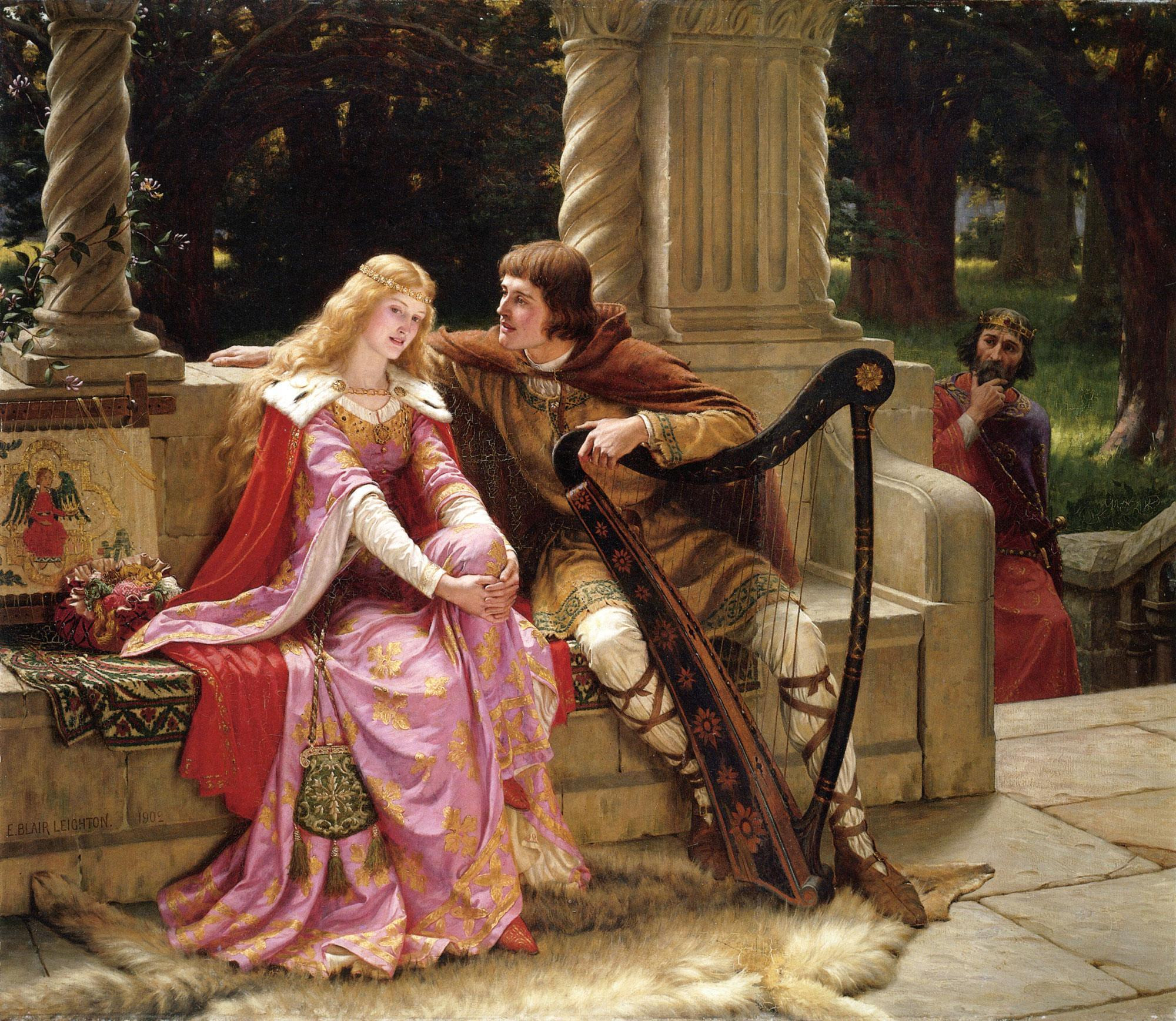
There are many themes, tropes, and values which emerged from or were popularized in courtly love writing which still survive in popular culture today. The major characters of courtly love literature are generally the male hero and the lady he decides to serve. Their love is considered “true, joyful and intense; it harmonizes with the commonweal and with divine intentions.”7 The hero is a gentleman, often a knight, devoted to worshipping and serving the lady, whom he considers the epitome of virtue. The lady is often in some way unattainable, usually married and considered morally and socially above the hero, and her character is idealized into near-sainthood.8 Her virtue motivates the knight on his quest to become worthy of her in spirit and deed, aiming for the values embodied in the chivalric ideal.
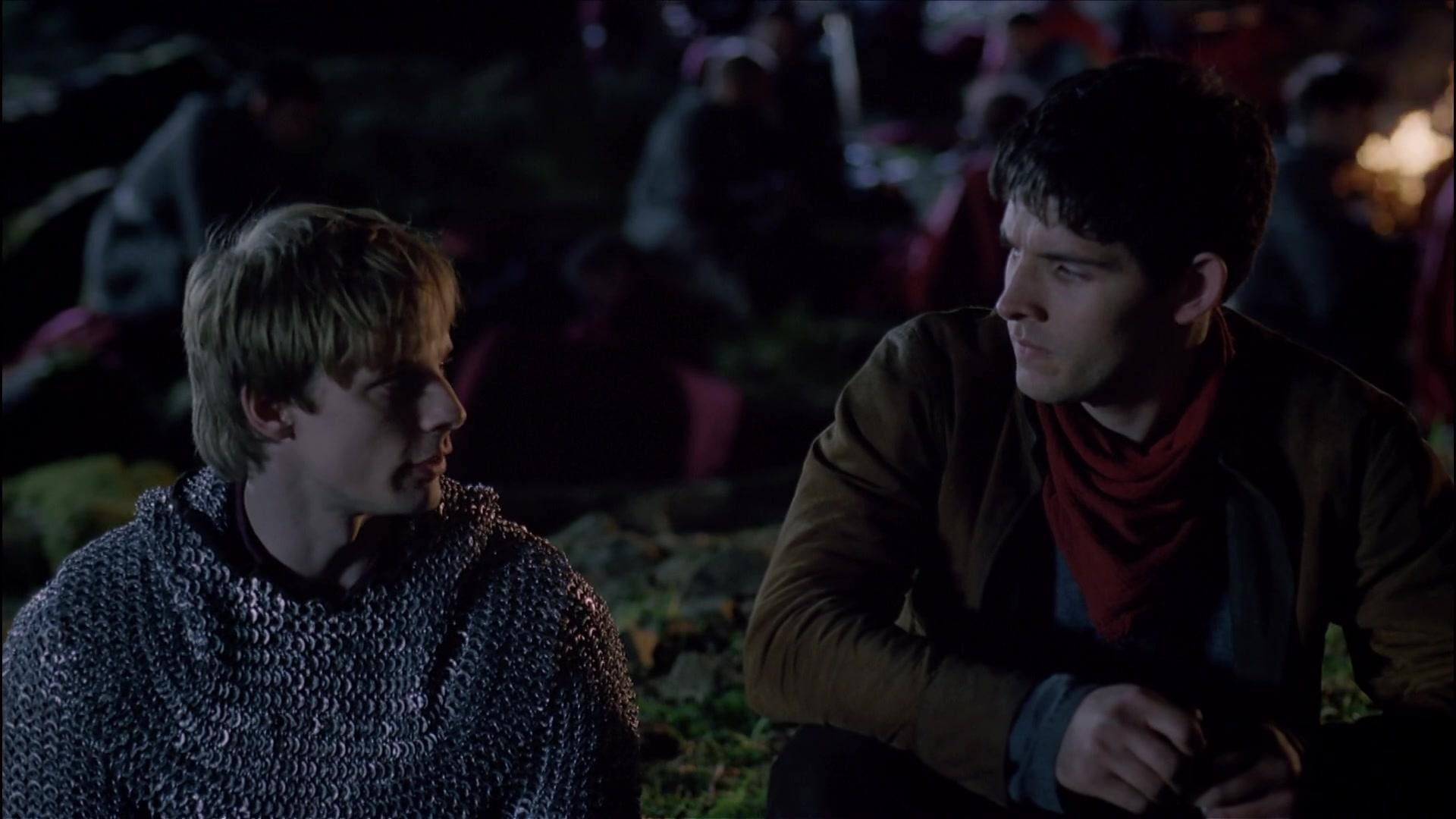
The BBC’s Arthurian-legend-inspired TV show Merlin (2008–2012) combines the older tradition of centering emotions shared between men with the courtly movement’s stylization of courtship between men and women. The show takes place in a Camelot where magic is declared illegal by Arthur’s father, who unfairly blames the death of Arthur’s mother on magic. Merlin must use his magic in secret to help Arthur face threats so that he can become the destined “Once and Future King,”9 who will eventually allow magic back into Camelot. Although the relationship between Merlin and Arthur is not portrayed as romantic in the modern sense of the word, it nevertheless displays many qualities associated with courtly love, arguably more than Arthur’s marriage to Guinevere. Moreover, the choice to begin the show with both characters young, with Arthur not yet a king and Merlin not yet the bearded wizard as seen in some modern interpretations, also helps to evoke the image of a young, passionate love. On the one hand, the relationship recalls the loyalty of a vassal to his lord as described by Lewis, given their differing ranks. On the other hand, Merlin acts as Arthur’s rescuer as well as an admirer of Arthur’s virtues, as in courtly romances, albeit with more nuance. When it is Merlin who needs saving, Arthur steps up as the rescuer instead. Their shared destiny of improving the realm casts them as two sides of the same coin,10 implying that their mutual devotion is in harmony with the world and divinely intended, as courtly love tends to be.
Another value closely linked to courtly love poetry and prose is chivalry. As defined by Barbara W. Tuchman: “More than a code of manners in war and love, chivalry was a moral system, governing the whole of noble life.”11 Emerging from the time of the Crusades and Christian values, chivalry grew to encompass virtues such as courage, honor, loyalty, and courtesy. The chivalric quest undertaken by a knight then became a popular narrative in combination with themes of courtly love. The quest often results in the knight’s rescue of a lady or, more rarely, the other way around, such as in the case of Marie de France’s downtrodden knight Lanval.12 In stories featuring courtly love, chivalry acted as a guide to idealized and stylized courting rituals in which the lady was considered most virtuous and worthy of servitude by her male suitor. As described by Tuchman, besides its extramarital nature, the chivalric love affair often involves the following stages:
The chivalric love affair moved from worship through declaration of passionate devotion, virtuous rejection by the lady, renewed wooing with oaths of eternal fealty, moans of approaching death from unsatisfied desire, heroic deeds of valor which won the lady’s heart by prowess, consummation of the secret love, followed by endless adventures and subterfuges to a tragic denouement.13
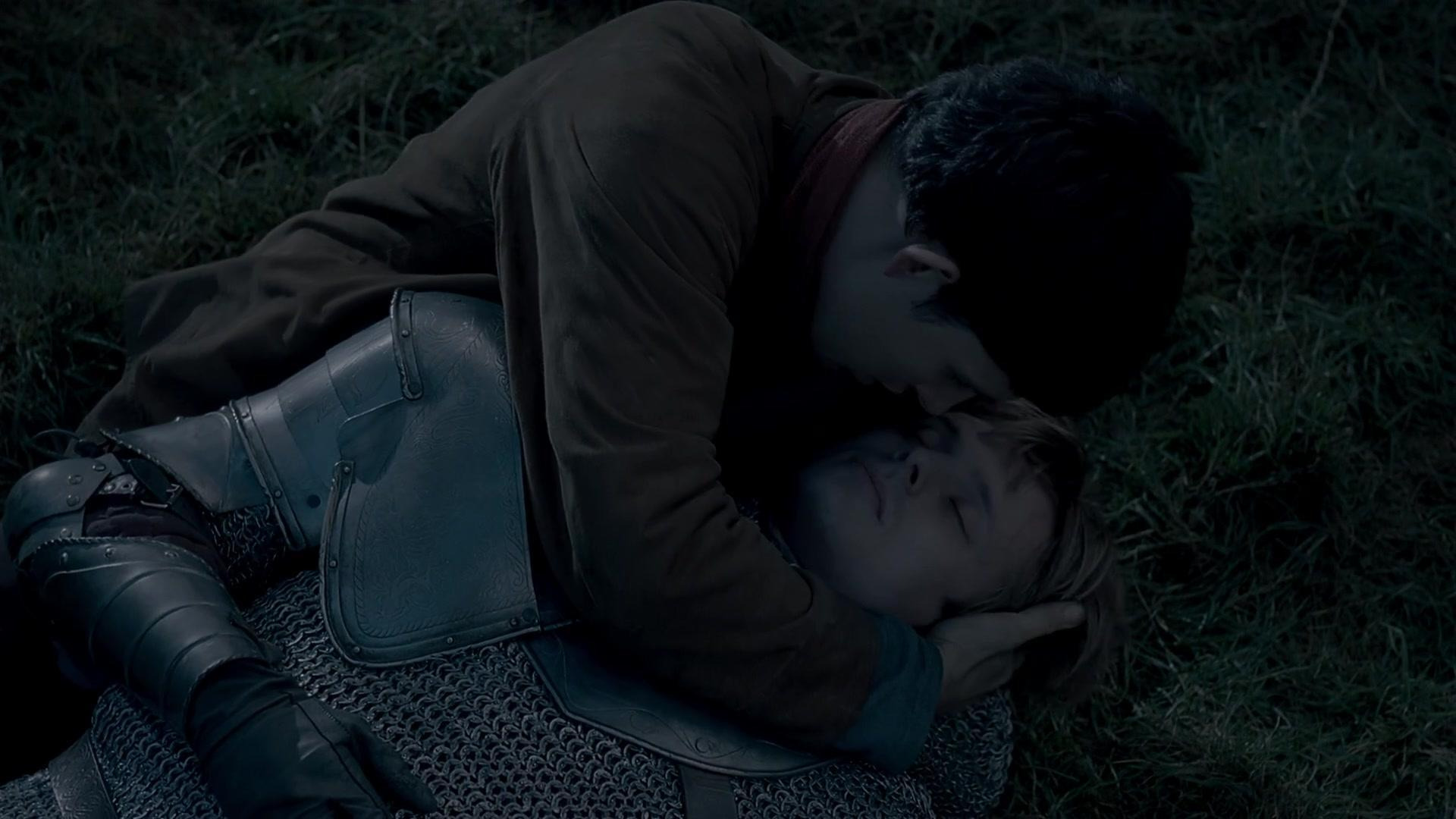
The development of Merlin and Arthur’s relationship follows various markers of chivalric love stories. Both Merlin and Arthur openly admire each other’s chivalric qualities. Merlin asserts that Arthur is “honest and brave and true-hearted, and one day [he] will be the greatest king this land has ever known.”14 In turn, Arthur tells Merlin at another point that he is “extremely brave and incredibly loyal and … not at all cowardly.”15 While not all of Tuchman’s stages are featured in the show’s affair, enough are present to establish a courtly pattern. Both characters make declarations of passionate devotion or fealty throughout the show. In the first series, Merlin tells Arthur that he is “happy to be [Arthur’s] servant ‘til the day [Merlin] die[s],”16 a sentiment he echoes in the final episode: “Some men were born to plough fields, … others to be great kings. Me? I was born to serve you, Arthur.”17 Arthur is more reserved in expressing his emotions, but he admits to Merlin: “You’re the only friend I have and I couldn’t bear to lose you.”18 Arthur fires Merlin after Merlin’s advice, given after having sworn that he would not lie to Arthur,19 leads to Arthur’s embarrassment in court. After Merlin is proved right, Arthur reinstates him as his manservant. This could be broadly interpreted as an initial rejection followed by an acceptance of Merlin’s sworn loyalty. Both characters show prowess and courage in heroic acts. Although not a knight, Merlin accompanies Arthur on every quest, which Arthur admires. Arthur, meanwhile, goes to Merlin’s village to fight bandits and later undertakes a quest to retrieve a flower for an antidote after Merlin drinks a poisoned cup meant for Arthur. In both cases, Arthur acts against his father’s orders, further emphasizing his devotion to Merlin. Such quests and adventures recur throughout the show, culminating in the tragic denouement. The show ends, as the legend of King Arthur does, with Arthur’s death. After Arthur is mortally wounded, Merlin transports him to the lake of Avalon in the hope of saving him, but they arrive too late. Arthur thanks Merlin and asks him to “hold [him]”20 before dying in his arms.
Finally, courtly love commonly features the theme of suffering for the sake of love. In the twelfth century, Andreas Capellanus declares among “The Rules of Love”: “The easy attainment of love makes it of little value; difficulty of attainment makes it prized.”21 Aldo Scaglione moreover describes another aspect of courtly love, stating that “not only did poets profess themselves incapable of communicating to the beloved the depth of their passion, but the very lack of communication was for them both a sign of its depth.”22 Denying fictional characters the satisfaction of consummating their passion, whether with words or action, or delaying it for dramatic effect, remains a popular storytelling tool in both medieval and modern love stories. This leads the reader or audience to be “transport[ed] … to a realm of heightened emotion,”23 making the depth of the characters’ emotions more pronounced throughout the story rather than only at its climax.
The self-denial and frustration characteristic of courtly love can be seen most clearly in the show’s treatment of Merlin’s magic. Keeping his magic a secret from Arthur brings both Merlin and Arthur much grief. Initially, Merlin does this out of self-preservation, given that the punishment for using magic is death, much like the punishment for adultery in the medieval period. However, in the last episode, he explains to Arthur that, while he trusted him, he did not want to put Arthur in the position of having to choose between his friend and honoring the law of his kingdom.24 This commitment to choosing Arthur over magic ultimately leads Merlin to betray the magical people. When Arthur learns the truth about why his father made magic illegal, he is on the brink of killing Uther for his treatment of sorcerers, but Merlin lies and convinces Arthur that the claims are not true so that Arthur would not have to suffer the regret of killing his father.25 On another occasion, Arthur asks the Disir, beings of the magical Old Religion, to save Sir Mordred. They tell him that, if he wishes to save his people and kingdom, he must “embrace the Old Religion.”26 Arthur considers the offer, interpreting it as a choice between Mordred’s life and his father’s law, and asks Merlin for advice. Because Merlin has been told that Mordred is destined to kill Arthur, he tells Arthur, despite himself, that “there can be no place for magic in Camelot.”27 He hopes that this means Mordred’s death, but in fact, as the Disir say, it “seal[s] [Arthur’s] fate … and that of [his] kingdom”28 because Mordred survives and later deals Arthur a mortal blow. The other side of the coin is Arthur’s blind trust in Merlin, which leads him to keep taking his advice. Magic never returns to Camelot during Arthur’s reign because Merlin’s devotion leads him to choose Arthur over magic, while Arthur chooses his trust in Merlin over his kingdom. Their loyalty to each other rather than to their respective peoples could even be considered a form of adultery, a disloyalty that ultimately dooms them both. In the last scene of the show, Merlin, who is revealed to be immortal, is shown in the present,29 still waiting for Arthur’s prophesied return “when Albion’s need is greatest.”30 He continues to suffer from his grief for more than a millennium, hoping to reunite with Arthur in the future.
It is obvious that medieval Arthurian literature was a major inspiration for the writers and directors of Merlin (2008–2012). Since the height of medieval Arthuriana is intrinsically linked with courtly literature due to the popularity of Arthurian narratives among troubadours and other writers, it is inevitable that this tradition informed the values and themes of the show as well. The show notably references two of the most famous stories of courtly love: that of Tristan and Isolde, who appear as a couple helping Arthur during an attack on Camelot, and that of Guinevere and Sir Lancelot, who nearly become lovers until BBC’s Lancelot decides not to stand in the way of Guinevere and Arthur’s relationship and steps away, unlike the Lancelot of the legends. Rather than reproducing courtly love through these typical characters, the show, intentionally or not, has Merlin represent the figure of the devoted knight and Arthur that of the noble lady, although they can freely switch roles. Both undertake heroic quests and embody chivalric values such as courage and loyalty, but in the end, not unlike courtly lovers condemned by the sin of adultery, Merlin and Arthur are separated by death. While in the legends Guinevere’s affair with Sir Lancelot leads to King Arthur’s demise, in the show, it is Merlin’s loyalty to Arthur and vice versa, a form of adultery in itself, that results in the king’s death. After Arthur dies, the dragon Kilgharrah tells Merlin: “The story we have been a part of will live long in the minds of men.”31 Indeed, the patterns of courtly love in the relationship between Merlin and Arthur, from their passionate devotion to each other to their tragic ending, aided the fans’ emotional investment in the characters and the show as a whole, even years after its final episode aired.
Bibliography:
Capellanus, Andreas. The Art of Courtly Love. Translated by John Jay Parry. New York: Columbia University Press, 1941.
Cormier, Raymond J. “‘You Make Me Want to Be a Better Man’: Courtly Values Revived in Modern Film.” In The Legacy of Courtly Literature: From Medieval to Contemporary Culture, edited by Deborah Nelson-Campbell and Rouben Cholakian, 79–90. Cham: Palgrave Macmillan, 2017.
Hawes, James, dir. Merlin. Series 1, episode 1, “The Dragon’s Call.” Aired September 20ᵗʰ, 2008, on BBC One.
Hawes, James, dir. Merlin. Series 1, episode 3, “The Mark of Nimueh.” Aired October 4ᵗʰ, 2008, on BBC One.
Hawes, James, dir. Merlin, Series 1, episode 2, “Valiant.” Aired September 27ᵗʰ, 2008, on BBC One.
Huseyin, Metin. Merlin. Series 2, episode 8, “The Sins of the Father.” Aired November 14ᵗʰ, 2009, on BBC One.
Lewis, C. S. The Allegory of Love: A Study in Medieval Tradition. Oxford: Oxford University Press, 1958.
Molotnikov, Justin, dir. Merlin. Series 5, episode 13, “The Diamond of the Day – Part 2.” Aired December 24ᵗʰ, 2012, on BBC One.
Moore, David, dir. Merlin. Series 1, episode 13, “Le Morte d’Arthur.” Aired December 13ᵗʰ, 2008, on BBC One.
Nelson-Campbell, Deborah, and Rouben Cholakian. “Introduction.” In The Legacy of Courtly Literature: From Medieval to Contemporary Culture, edited by Deborah Nelson-Campbell and Rouben Cholakian, 1–8. Cham: Palgrave Macmillan, 2017.
Pillai, Alex, dir. Merlin. Series 4, episode 6, “A Servant of Two Masters.” Aired November 5ᵗʰ, 2011, on BBC One.
Scaglione, Aldo. “Petrarchan Love and the Pleasures of Frustration.” Journal of the History of Ideas 58, no. 4 (1997): 557–72. https://doi.org/10.2307/3653960.
Troughton, Alice, dir. Merlin. Series 4, episode 12, “The Sword in the Stone – Part 1.” Aired December 17ᵗʰ, 2011, on BBC One.
Troughton, Alice, dir. Merlin. Series 4, episode 13, “The Sword in the Stone – Part 2.” Aired December 24ᵗʰ, 2011, on BBC One.
Tuchman, Barbara. A Distant Mirror: The Calamitous 14th Century. New York: Ballantine Books, 1978.
Way, Ashley, dir. Merlin. Series 5, episode 5, “The Disir.” Aired November 3ʳᵈ, 2012, on BBC One.
Notes:
- C. S. Lewis, The Allegory of Love: A Study in Medieval Tradition (Oxford: Oxford University Press, 1958), 11. ↩︎
- Lewis, The Allegory of Love, 9. ↩︎
- Lewis, The Allegory of Love, 9. ↩︎
- Lewis, The Allegory of Love, 13. ↩︎
- Lewis, The Allegory of Love, 9. ↩︎
- Lewis, The Allegory of Love, 13. ↩︎
- Raymond J. Cormier, “‘You Make Me Want to Be a Better Man’: Courtly Values Revived in Modern Film,” in The Legacy of Courtly Literature: From Medieval to Contemporary Culture, ed. Deborah Nelson-Campbell and Rouben Cholakian (Cham: Palgrave Macmillan, 2017), 79. ↩︎
- Deborah Nelson-Campbell and Rouben Cholakian, “Introduction,” in The Legacy of Courtly Literature: From Medieval to Contemporary Culture, ed. Deborah Nelson-Campbell and Rouben Cholakian (Cham: Palgrave Macmillan, 2017), 5. ↩︎
- Merlin, series 1, episode 1, “The Dragon’s Call,” directed by James Hawes, aired September 20ᵗʰ, 2008, on BBC One; 31:11. ↩︎
- Merlin, series 1, episode 3, “The Mark of Nimueh,” directed by James Hawes, aired October 4ᵗʰ, 2008, on BBC One; 31:44. ↩︎
- Barbara Tuchman, A Distant Mirror: The Calamitous 14th Century (New York: Ballantine Books, 1978), 62. ↩︎
- Cormier, “‘You Make Me Want to Be a Better Man,’” 80. ↩︎
- Tuchman, A Distant Mirror, 67. ↩︎
- Merlin, series 4, episode 12, “The Sword in the Stone – Part 1,” directed by Alice Troughton, aired December 17ᵗʰ, 2011, on BBC One; 35:10. ↩︎
- Merlin, series 4, episode 6, “A Servant of Two Masters,” directed by Alex Pillai, aired November 5ᵗʰ, 2011, on BBC One; 3:35. ↩︎
- Merlin, series 1, episode 13, “Le Morte d’Arthur,” directed by David Moore, aired December 13ᵗʰ, 2008, on BBC One; 32:46. ↩︎
- Merlin, series 5, episode 13, “The Diamond of the Day – Part 2,” directed by Justin Molotnikov, aired December 24ᵗʰ, 2012, on BBC One; 28:33. ↩︎
- Merlin, series 4, episode 12, “The Sword in the Stone – Part 2,” directed by Alice Troughton, aired December 24ᵗʰ, 2011, on BBC One; 7:52. ↩︎
- Merlin, series 1, episode 2, “Valiant,” directed by James Hawes, aired September 27ᵗʰ, 2008, on BBC One; 23:36. ↩︎
- “The Diamond of the Day – Part 2,” 39:19. ↩︎
- Andreas Capellanus, The Art of Courtly Love, translated by John Jay Parry (New York: Columbia University Press, 1941), 185. ↩︎
- Aldo Scaglione, “Petrarchan Love and the Pleasures of Frustration,” Journal of the History of Ideas 58, no. 4 (1997): 557–72, https://doi.org/10.2307/3653960. ↩︎
- Cormier, “‘You Make Me Want to Be a Better Man,’” 86. ↩︎
- “The Diamond of the Day – Part 2,” 27:59. ↩︎
- Merlin, series 2, episode 8, “The Sins of the Father,” directed by Metin Huseyin, aired November 13ᵗʰ, 2009, on BBC One; 38:32, 42:16. ↩︎
- Merlin, series 5, episode 5, “The Disir,” directed by Ashley Way, aired November 3ʳᵈ, 2012, on BBC One; 35:32. ↩︎
- “The Disir,” 38:56. ↩︎
- “The Disir,” 40:01. ↩︎
- “The Diamond of the Day – Part 2,” 46:39. ↩︎
- “The Diamond of the Day – Part 2,” 42:43. ↩︎
- “The Diamond of the Day – Part 2,” 42:56. ↩︎